Refana
  • Home
  • Narcotic ID
    • Grant Funding
  • Research
  • Team
  • About
  • Blog

9/3/2021

Covid-19 Vaccines - Is Anything Better Than mRNA?

0 Comments

Read Now
 
Recent analyses of populations experiencing further waves of COVID-19 infection based on the Delta variant indicate that new challenges are emerging in the fight against the COVID-19 Pandemic: Some in-use vaccines are failing to provide long-run protection against the rapidly evolving COVID-19 virus, whereas others appear to be showing better long-term performance. See our analysis in our Industry Update 11.
​
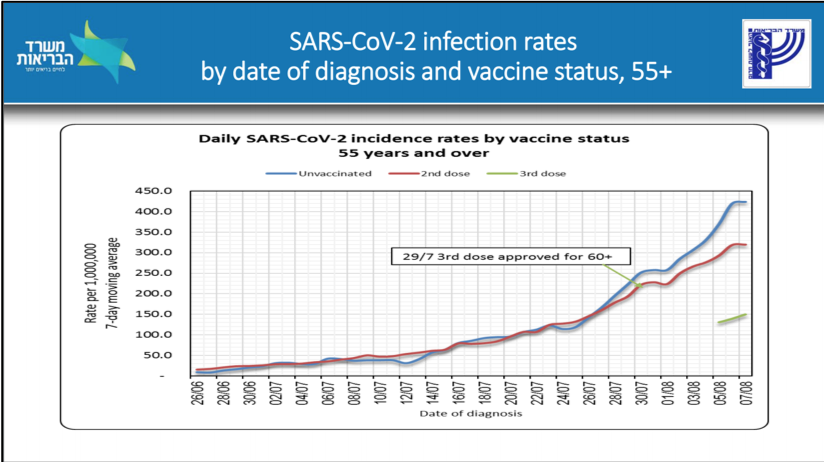
  • For example: Double vaccination protocols with Pfizer/BioNTech’s mRNA-base COVID-19 vaccine in Israel did NOT prevent most infections by the Delta variant, although the protocol does reduce the risk of hospitalization for serious COVID-19 illness
  • Given that Pfizer/BioNTech’s vaccine does not prevent either infection and/or transmission of the Delta variant in many cases, the concept of ‘Herd Immunity’ against Delta becomes moot
    • Most COVID-19 policy-decisions world-wide are largely driven on the objective of achieving herd immunity
  • Israel’s analysis of recovery from a prior natural COVID-19 infection had determined that it provides protection against the Delta variant that is 10X – 13X+ times more powerful than the protection provided by the current Pfizer/ BioNTech two dose protocol
    • This has important implications on the need for/frequency of booster shots to maintain strong immunity levels, along with the need to frequently update the vaccine formulations to ‘keep up’ with rapidly evolving COVID-19 variants
Daily SARS CoV-2 Incidence rates
Israeli Ministry of Health figures illustrate how two shots of the Pfizer/BioNTech vaccine is providing very little protection against the Delta variant.
  • Alternatively, evidence is emerging suggesting that vaccines based on the whole virion (Whole Inactivated Virus – WIV vaccines) are providing better and longer-range immunity and protection against the most recent variants
    • Driven by the WIV vaccine’s basic structure which is similar to the natural infection of COVID-19 and exposes the immune system to the whole virion, not just the Spike protein
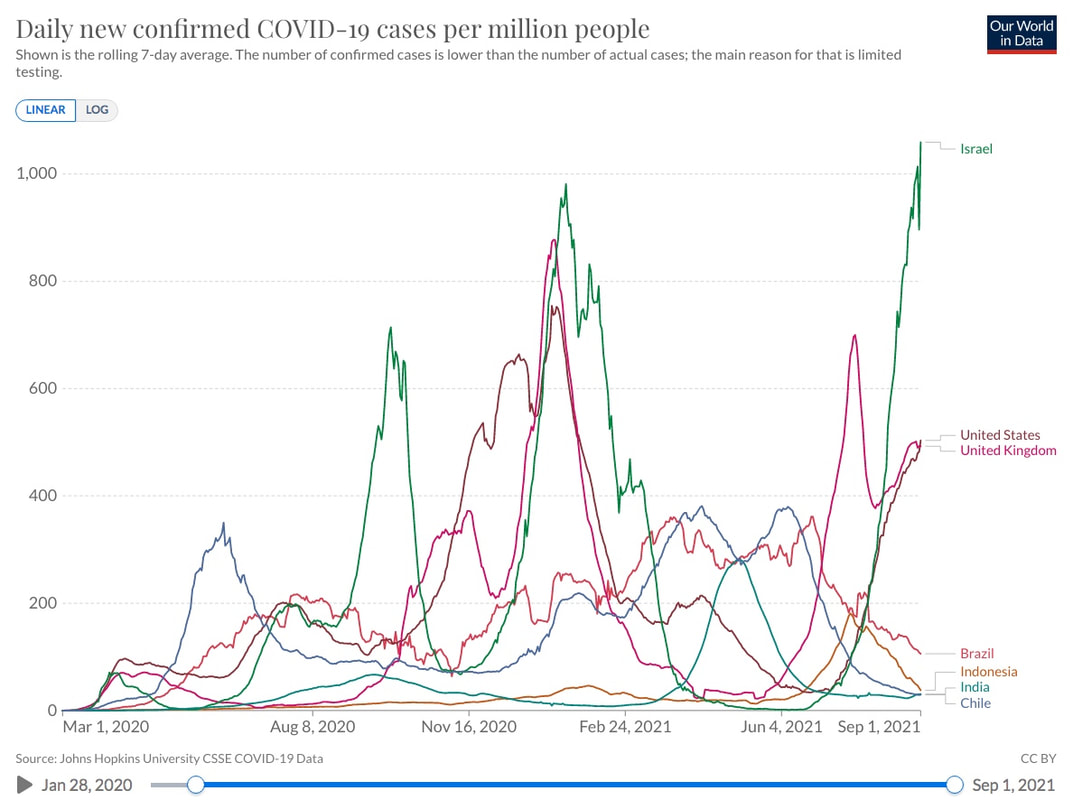
Daily COVID cases
Image from Our World In Data
  • Data from countries relying substantially on WIV vaccines are NOT experiencing a Delta surge comparable to countries relying predominantly on Spike protein-only vaccines.
  • There also appear to be marked differences in your immune system after a natural infection with coronavirus and after vaccination.
  • A substantial amount of research suggests that a second or third shot of a DIFFERENT type of vaccine appears to provide greater protection than more shots of the same. This finding however appears to have been ignored in both the Israeli and US booster shot decisions.

The current situation with vaccines world-wide strongly supports the following hypotheses:
  • A whole virion (WIV) vaccine creates an immune response that is much closer to actual infection from Covid, as compared to vaccines relying solely on the Spike protein
  • A whole virion WIV vaccines will therefore provide significantly higher protection against the Delta surge
  • Any Covid vaccine modeled directly on the Delta variant will provide more protection than the SAME vaccine modeled on the much earlier Wuhan strain (i.e., all current vaccines)
  • An ideal vaccine should carry 'multiple payloads' as there will be further evolution of new variants, most likely continually derived from the now dominant Delta strain.

Back to Blog

Share

0 Comments

7/29/2021

Industry Updates Volume 10

0 Comments

Read Now
 
Picture
Global Pandemic
  • The world will pass 200 Million confirmed cases of Covid-19 by the end of July, with an average death rate of over 2% of confirmed cases.
  • The ongoing pandemic is now driven by the Delta variant, ~83% of all new cases in the U.S.
  • Research from the UK, Israel and elsewhere are recording 'breakthrough' infections, where someone already vaccinated with e.g., two Pfizer shots, nevertheless becomes infected, and in some cases is hospitalized and dies. 
    • Research shows a significant drop of effectiveness of the vaccines against Delta, but a range of results, from a drop of 12% to as high as nearly 50%.
    • Pfizer’s mRNA vaccine has been shown to be specifically less effective with older people.
  • The CDC Director warned this week that while current vaccines still protect against severe COVID-19 in a majority of cases, “We are just a few mutations away from“ a further evolution of COVID-19, which will be capable of completely evading current vaccines - all of which are based on the original Wuhan strain, and not the current prevalent variants.
    • This view is shared by Prof Gupta of Cambridge University.
  • Some research suggests the Delta variant creates up to 1,000 times greater viral load in infected people, and this occurs rapidly in the first few days, making testing, quarantine and tracing less effective in reducing transmission.
  • Lancet reported a UCL study showing that the antibodies created by Pfizer and AstraZeneca vaccines start to wane after 6 weeks, and can reduce by more than 50% after 10 weeks.
  • Current immediate answers to this challenge range from suggesting a third shot of an existing vaccine (e.g., 3rd Pfizer shot in Israel), to mixing different types of vaccines, which has been shown to generate a better immune response than more shots of the same.
  • Long term solutions will likely be vaccines that will protect against Delta, future variants.

Vaccinations
  • While Delta is a serious concern even in countries with high vaccination rates, it is absolutely devastating in less vaccinated populations.
  • Although almost 4 billion vaccines have now been administered, the 'Vaccination Gap' has become ever wider.   The world is now clearly split into 4 categories with respect to vaccination rates:
    • 'RICH COUNTRIES' and CHINA: 54-64%; e.g., Canada 64%; UK 63%; Israel 61%; China 56%; EU 55%; USA 54%; also UAE 77% and surprisingly, Chile 56%.
      • There are a few 'laggards' in the rich countries, e.g., Saudi Arabia 37%; Japan 33%; South Korea 24%; Australia 22%.
    • 'MIDDLE INCOME': 19%-33%; e.g., Brazil 33%; Argentina 33%; Morocco 31%; Columbia 25%; Mexico 24%; Russia 19%.
    • 'FASTER LOWER INCOME’: 6-16%;  e.g., India 16%; Indonesia 12%; Thailand 12%; Ukraine 8%; Philippines 8%; South Africa 7%; Pakistan 6%; Iran 6%.
    • 'SLOW LOW INCOME': 1-3% e.g., Egypt 3%; Vietnam 3%; Bangladesh 3%; Angola 3%; Iraq 2%; Kenya 2%; Ghana 2%; Nigeria 1%; Ethiopia 1%; Algeria 0.1%.
  • A unique risk of the "Pandemic of the Unvaccinated" exists in the U.S., given large geographical areas comprising almost one-third of the country with vaccination rates below 30%. 
    • U.S. new cases/day have increased 5X in the past month; now @ 57,000 per day.

Industry
  • Market leader Pfizer, has recommended "more of the same" i.e., a 3rd shot of Pfizer to offset declining antibody levels; logic being that sufficiently high levels will largely protect against Delta. 
    • The profitability of selling 'more of the same' greatly exceeds the costs and potential loss of momentum of developing a new vaccine and going back through approvals.
    • They recently raised their annual sales forecast by almost a third to $33 Billion
  • As expected from a commercial perspective, everyone else, except Pfizer, is emphasizing how the research shows better antibody response from mixing the types of vaccine so the second or third shot should NOT be the same as the first/second shot!
    • This implies that everyone who got Pfizer shots should now get something else!
  • The 'something else' logic however does not help Moderna commercially, because it is too similar to Pfizer to be used as a different vaccine.
  • Moderna announced they are working on new vaccines more targeted to the latest variants.
  • Medically, there is no doubt that the best way to tackle the Delta challenge is a vaccine designed specifically to prevent Delta. 
  • Sinovac has signed long-term agreements with UNICEF and Covax for an estimated 380 Million doses of CoronaVac WIV vaccine.

Back to Blog

Share

0 Comments

6/29/2021

Industry Updates Volume 9

0 Comments

Read Now
 
Picture
​Global Pandemic
  • Globally, the pandemic shows no sign of abating as global deaths reach 4 million
  • The majority of COVID-19 related deaths have occurred in the past 6 months
    • World-wide COVID-19 death toll in first 6 months of 2021 exceeds total COVID-19 deaths in 2020
    • U.S. passed 600,000 deaths in mid-June
    • Fears that the pandemic in India is spreading to neighbouring countries
    • Brazil passed 500,000 deaths; with severe outbreaks in other Latin American countries, e.g., Columbia, at 100,000 deaths
    • New COVID-19 hot spots have also broken out, for example in Kenya in East Africa
  • The ‘common theme’ across these outbreaks and hot spots is the Delta variant, which originated in India; the prediction that "No One Will Be Safe, Until Everyone Is Safe" is becoming reality
    • Delta making substantial inroads, in countries: 1) WIth high vaccination rates (e.g., Israel, the UK); 2) With strong isolation/tracing (e.g., Australia) and 3) Where prior variants dominated (e.g., South Africa, with the Beta variant)
    • Delta variant represents 99% of new infections in the UK and is predicted to reach 90% of all infections in Europe by August
    • Former U.S. FDA Commissioner - now a Director at Pfizer - Dr. Scott Gottlieb predicted that U.S. is two months behind the UK in the penetration of the Delta variant - and to expect  local mini-Pandemics in locales in the U.S. with low vaccination rates (482 U.S. counties have vaccination rates < 25%)
    • The CDC Director pleaded for people to get vaccinated to prevent “Completely avoidable deaths”
  • Over 3 Billion vaccine doses administered to date - 40% of those are in China
    • China represents ½ of the 43 Million doses currently being administered per day and 5 countries (China, India, U.S., UK, Brazil) plus the EU accounts for 80% of vaccines administered so far
  • The recent G-7 summit started positively, with President Biden's commitment to provide 500 Million doses of the Pfizer-BioNTech vaccine to lower-income countries, and the expectations of total pledges of 1 Billion doses from all the G7 nations
    • Final communique referenced 870 Million doses
    • Duke University reported a real 'new commitment' of only 648 Million doses, when prior, recycled pledges and existing EU schemes were discounted
    • Duke forecasts that it will take well into 2023 to reach even 60% of the target global population globally vs. the 70% considered to be the minimum to be effective.

Industry
  • Pfizer-BioNTech and Moderna maintain their market leadership in the West, but there is a loss of lustre to their crown, for several reasons;
    • As new variants diverge further from the original Wuhan strain - which existing vaccines are based on - the amount of antibodies generated in defense by these vaccines falls by up to 80%
    • In Israel, there have been reports of people fully-vaccinated with two doses of Pfizer becoming infected; Israel has re-introduced mask-wearing and extended its travel ban for a further month
    • The side effect of heart myocarditis, caused by the mRNA vaccines in a small percentage of healthy, mostly young males, has been confirmed by the CDC, in more than 300 cases in the U.S.
  • On the positive side, this heart side-effect is not as life threatening as the blood clots caused by AstraZeneca and Johnson & Johnson, and also affects a lower percentage
  • President Biden chose to provide Pfizer-BioNTech vaccine in the 500 Million dose donation
    • Made it clear that this was an entirely new vaccine order vs. using up substantial pre-paid inventories of AstraZeneca and Johnson & Johnson doses under Operation Warp Speed
    • Perhaps to prevent any allegation that the U.S. passed off 'inferior products' on the 3rd World
  • Meanwhile, potential challenges to Pfizer/Moderna's leadership position in mRNA from German start-up CureVac receded, given that the CureVac mRNA trial failed to reach the minimum 50% efficacy hurdle
    • The EU and Germany had already partially pre-paid for 200 Million doses of the CureVac vaccine
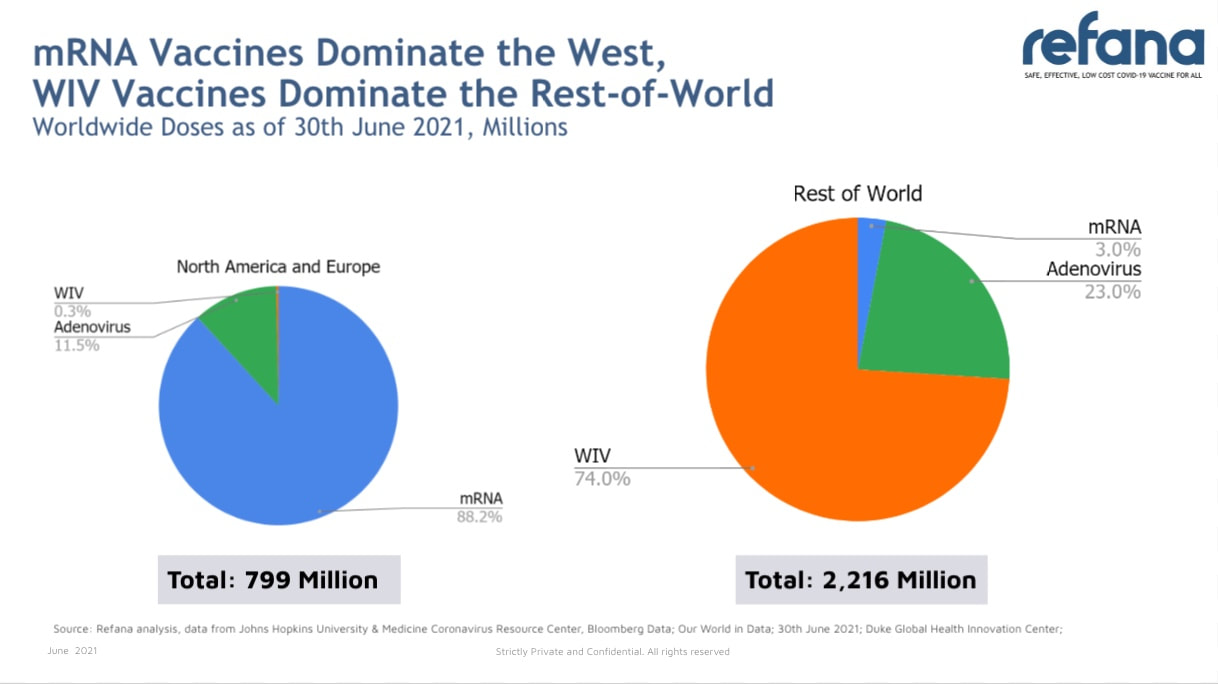
  • Outside of Europe and North America, the WIV vaccines dominate the market overall, with close to 80% of actual vaccinations in China, India and 70 other countries (Exhibit 1 below)
  • Bloomberg recognized this global WIV vaccine leadership position, given the volume of inoculations and number of countries involved with the Chinese Sinovac/Sinopharm vaccines, described as "good enough"
  • The Brazilian regulator failed both the Sputnik and Bharat vaccines after manufacturing site inspections
  • FDA has ordered the destruction overall of 60-70 Millions doses of both AstraZeneca and Johnson and Johnson vaccines in its ongoing review of troubled Baltimore Production Factory, Emergent BioSolutions
  • Novavax announced Trial results of up to 91% efficacy (and as low as 60%, based on other calculations)
    • They delayed their FDA submission by 3 months to September
    • Meanwhile, The Serum Institute of India (SII) announced they will begin manufacturing the vaccine.
WIV Vaccines Dominate the Rest-of-World
Back to Blog

Share

0 Comments

5/31/2021

Industry Updates - Volume 8

0 Comments

Read Now
 
Picture
Global Pandemic
  • 2020 warnings said that the ‘cornering’ of the vaccine market by the richest western nations would lead to a bifurcated world.  A year later, that world has emerged: The pandemic rages on and more mutations appear. The West is healing, while lower and middle income countries are still in deep despair.
  • The U.S. passed the 50% vaccination rate - 50.3% w/ at least one dose by end-of-May.  Vaccination rates have slowed considerably.  Peak was 4.2 Million shots/day - now down to 1.3 Million/day in a matter of weeks.  Current rate would take 5 more months to reach 75% of the target population.
  • U.S. Consumer research suggests that core Anti-Vaxxer segment may be as low as 18%, leading to an increase of incentive 'nudge economics" to encourage vaccination, including free participation in lotteries, discounts on supermarket shopping, free Uber and Lyft rides to get a vaccine - paid for by the White House - walk-in vaccinations at sporting events, e.g., at four locations at the Indy 500 auto race.
  • 70 Million unused vaccines exist within the U.S. distribution system, allowing same day, no appointment, walk-in vaccination, and even choice of vaccine, in much of the U.S..
  • Many other major western countries are catching up (France 36%, Germany 43%) and a few are ahead (UK 58%, Canada 55%, Chile 54%, Hungary 52%).
  • For advanced economies in the West, the pandemic is seen as coming under control, and attention is shifting to: 1) Incentives needed to get close to herd immunity, (at least 70%); 2) How long does immunity last; and 3) Combating dangerous new variants. In the UK and France, a 3rd round of shots has already been arranged, with longer term plans for annual boosters for the next 3 to 5 years.
  • Some advanced economies have lagged behind: Australia 14%; South Korea 9%; Japan 6%. In Australia the Qantas airline is offering unlimited flights for a year incentive to support the vaccine push.
  • Rest of the world? Global cases now exceed 171 Million with over 3.6 Million deaths officially reported. 
  • 85% of the 1.91 Billion vaccine shots administered have been in upper income countries, but only 0.3% of shots in low-income countries. Of the daily global vaccination rate of 34 Million per day, 25 Million are taking place in China, USA, EU and UK. This leaves just 9 Million per day for the "other 5 Billion people". 
  • India with a population of nearly 1.4 Billion, and a large domestic vaccine manufacturing industry, is achieving just 2.5 Million vaccinations a day, allowing the pandemic to continue to spread, and leading to somewhere between 4,000 (official) and 20,000 (unofficial estimates) deaths per day.
  • Refana has modeled vaccine availability/administration for the remaining 3.5 Billion people - 5 billion less India, 45% of the world's population - forecasts 5 years to achieve a 70% vaccination rate globally.

The Business of Vaccines
  • The WHO has now approved two Whole Inactivated Virus Vaccines (WIV) for Emergency Use Access, Siopharm and now Sinovac, both produced in China.
  • Airfinity market study reports that 2021 would see between $115-$190 Billion of actual vaccine sales this year, almost equalling the entire previous 5 year market forecast of $157 Billion for 2021-2025. These figures represent potential given reported orders, but may be constrained given production constraints.
  • A significant factor in these large market values is that vaccine pricing is at a level 300% higher than prior earlier forecasts, as the enormous value of Covid vaccines, even at these prices, is being clearly recognized compared to the human and economic costs of the pandemic.
  • The big winners forecast by Airfinity for 2021 revenue are Pfizer-BioNTech at $44 Billion, Moderna at $32 Billion, Sinovac at $25 Billion and Sinopharm at $23 Billion.

Medical/ Vaccine Updates
  • SARS-CoV-2 is mutating at an alarming rate.  New mutations are progressively more virulent, with increased capacity to both infect and cause more severe illness. 
  • While single “epitope” vaccines (e.g. Pfizer, Moderna, Novovax, J&J) continue to show efficacy against new variants, the efficacy/ protection of these vaccines is significantly reduced. 
  • Given > 50% vaccination of populations in wealthy countries, new variants are unlikely to spread in those countries. Even with reduced efficacy, vaccines still slow the spread significantly: “Shifting the curve”
  • BUT, given epidemiological considerations of variant spread, less vaccinated 2nd/3rd world countries will need to utilize new vaccines effective against the new variants, to significantly reduce disease spread. 
  • Recent analysis shows that in 18-36 months, new variants of SARS-CoV-2 may have mutated sufficiently to enable reinfection in populations vaccinated with existing vaccines for the earlier variants. To prevent this outcome, the reservoir of new variants from the unvaccinated poorer populations will have to be eliminated through broad and comprehensive vaccination programs. ​
Back to Blog

Share

0 Comments

4/9/2021

Industry Updates - Volume 7

0 Comments

Read Now
 
Covid-19 Industry Updates Volume 7
There is a media debate as to whether the pandemic is stabilizing, or whether we are entering a dangerous new 3rd and 4th wave, driven by toxic new mutations to the virus, such as the UK, South African, and Brazilian variants. Refana's view is as follows:

​Global Pandemic
  • Total deaths attributed to Covid-19 worldwide have just reached 3 million (Bloomberg). While this is a horrific total, the death rate globally may have begun to plateau.
  • It took approximately 9 months to the end of September for the first 1 million deaths to occur, but just 3.5 months to mid-January for the 2nd million; and almost the same period again (just under 3 months to the first week of April) for the 3rd million.
  • There is clear evidence from Israel, the UK, and early indications in the US, that the vaccine campaigns are working; even as cases continue to rise significantly in a number of US states.
  • Israel has successfully implemented a major 're-opening' of the economy and large scale social and cultural events, utilising a 'digital passport' for vaccinated people.
  • The EU is lagging due to its vaccine supply and logistical issues (vaccination coverage rate of just 9% in the EU so far compared to approx 26% in UK and US, and over 50% in Israel) but this is expected to be resolved by the second half of the year. Major new lockdowns are being implemented in a number of leading countries, including France and Canada.
  • Worldwide we are getting close to where 5% of the population has now had one vaccine. The current rate of 16 million shots per day could cover the globe, on a two shot regime, in about 800 days. But in practice this will likely take longer, as over 70% of the current vaccinations are in just 3 large countries, China (5 million per day), India and the USA (>3 million per day each and rising).
  • The Refana view is that the Pandemic will switch to Endemic status in the advanced countries, once enough vaccinations have occurred; and the focus in these countries will be on dealing with new variants and booster shots from the end of 2021. But in less developed regions, the Pandemic is likely to continue for the next 24 months, before turning to Endemic status everywhere. 
  • In Brazil the pandemic seems to be getting out of control with hospitals overwhelmed, dangerous new variants emerging, inadequate supply of vaccines and over 4,000 deaths per day.
  • In India the situation in a number of states in India is also extremely severe. The Indian government has banned the export of any vaccines manufactured in India until July, which will have a serious impact on many other lower income countries.

Industry and Economics
  • Pfizer/BioNTech and Moderna have become the clear market leaders, especially in the advanced economies.
  • AstraZeneca continues to struggle, most recently in a link established by the European Medicines Agency between the vaccine and a rare form of blood clot, that has particularly affected younger to middle aged females. While the risk is perhaps only 1/100,000 overall it may actually be 1/25,000 in the highest risk groups. Conversely the risk of death from the Coronavirus in developed economies for females aged 18 to 50 is no more than 1/20,000. Of 69 recorded cases in the EU today there have been 23 deaths. Multiple countries have now restricted the use of the AstraZeneca vaccine.
  • For lesser developed countries the World Health Organization (WHO) continues to recommend AstraZeneca, but this may change as a number of African countries have announced that they will refuse to accept this vaccine. It is currently not clear whether or not AstraZeneca will continue to seek EUA from the FDA in the United States. Despite earlier announcements, no date has been set for the hearing. Meanwhile the SAGE committee of the WHO is currently reviewing the Whole Inactivated Virus vaccines from Sinopharm and Sinovac, and is likely to grant them EUA status during April.
  • A small number of cases similar to the AstraZeneca blood clots have been attributed to the Johnson & Johnson vaccine. If this problem applies to Johnson & Johnson as well as AstraZeneca it may be an intrinsic problem of all Adenovirus vaccines, which includes the Chinese Cansino and Russian Sputnik V.
  • In the EU significant quantities of Pfizer and Moderna are to be delivered in the coming months which will be urgently needed if AstraZeneca and possibly Johnson & Johnson will no longer be widely used.
  • Russia's efforts to promote the Sputnik vaccine in Europe are running into controversy. The Prime Minister of Slovakia lost his position after the batch of Sputnik Vaccines he purchased from Russia, were found to be different to the one reviewed in The Lancet. The EMA has requested data which has not been provided. There is also a complaint that the data used in early testing did not meet ethical guidelines. The Russian Direct Investment Fund has just signed contracts with 6 Indian firms to manufacture the Sputnik Vaccines to GMP quality standard (following manufacturing problems in Russia).
  • The UAE has concluded a deal with Sinopharm for technology transfer to support manufacture of this WIV vaccine by a UAE company, Group 42.
  • Bharat's US partner Ocugen says they will be submitting their WIV vaccine to the FDA for EUA.
  • Valneva is commencing a Stage 3 trial of its WIV vaccine in the UK, having issued a press release of positive Stage 2 results.
  • Johnson & Johnson got off to a slow start after obtaining EUA due to production issues which spoiled 15 million doses in the U.S. The New York Times reported that a further 64 million doses may have also been contaminated.
Back to Blog

Share

0 Comments

3/10/2021

Industry Updates - Volume 6

0 Comments

Read Now
 
Picture
March has seen warnings of a 4th Wave, emergency use approval for a 1-shot vaccine and an increase in vaccine sales. Volume 6 looks at these headlines and more.
​
Global Pandemic
  • Global caseload up to almost 120 Million cases, 2.6 Million deaths
  • World Health Organization and CDC in U.S. issued warnings for a '4th Wave' of Covid-19 cases, triggered by more contagious COVID-19 variants from UK, South Africa, Brasil, elsewhere
  • However, the overall trend in new infections/deaths has been trending downwards in many countries for almost two months
  • U.S. situation is complex - 20+ states have seen increases in infections in recent weeks, even as a number of states - led by 2nd most populous state Texas (29 million people) - cancelled mask mandates and are opening up
  • Vaccination programs in two major countries - U.S. and the UK - have significant momentum 
    • U.S. now at 2+ million vaccinations/day; Biden administration projects there will be sufficient vaccines for everyone who wants to take them by May
    • 312 Million vaccinations world-wide
    • 2/3rds of all doses have been administered in U.S., UK, China, EU Countries
    • 100 countries still without any vaccinations
  • Israel reached vaccine doses administered of 7.5 Million, compared with its population aged 15 or older of 6.7 Million
    • Covid infections in the 50+ age group have fallen from 25% to 11% of new infections, while 47% are in the 19 or younger age group
    • Israel re-opening large venues (e.g., sports stadiums, concert halls) allowing access to Green digital passport holders which attest to full vaccination or antibodies from prior infection
    • Fears however as to the risks from the South African variant which has arrived; and the ‘R Rate’ still stubbornly close to 1, vs. 0.5-0.7 if the Pandemic is subsiding.

Industry
  • Johnsons & Johnson (J&J) one-shot vaccine was given EUA on 28 February
    • U.S. efficacy of 72% (but lower elsewhere, presumably due to new COVID-19 variants) compared to 94% for the mRNA competitors
    • Leading officials - including Dr, Fauci and the acting FDA Commissioner Janet Woodcock - stated that there is no real difference between these vaccines w.r.t. to serious outcomes
    • People should simply take whatever they can get
    • White House brokered deal between rivals Merck, J&J to increase production of J&J’s vaccine
  • Research shows that Pfizer vaccine produced 67% less antibodies against the South African variant; and Moderna produced 83% less antibodies
    • Implications for protection not clear; both companies are working on new vaccines (or booster shots for those previously inoculated) against South African variant
  • AstraZeneca expected to announce shortly that it has achieved enough events in its Stage 3 American trial to read data and make application to the FDA for EUA
  • The European Medicines Agency (EMA) has commenced a review of the Russian Sputnik V vaccine; officials cautioned that they have not received the data required on vaccinated people
    • Surveys in Russia found that 60% of Russians did not trust the Sputnik vaccine
  • The Chairman of Sinopharm - which has previously announced 79% efficacy for their WIV vaccine - said it was effective against new variants, including the South African variant
  • Reuters reported that Sinovac was effective against the Brazilian variant
  • Sinovac announced an updated efficacy rate from its Turkish trial of 83.5%
    • Mexico, Thailand, The Philippines, and Hong Kong have approved Sinovac’s WIV vaccine
    • Meanwhile, Ukraine fined local distributor of Sinovac for failing to deliver the vaccine on time
  • In India, Bharat announced Stage 3 results of its WIV vaccine, showing 81% efficacy
  • The WHO has granted EUA to Pfizer, Moderna, and AstraZeneca and will review next Sinopharm, Sinovac and J&J.

Financial news
  • Bharat sold 20 Million doses of its WIV vaccine to Brazil for U.S. $290 Million ($14.50/shot), even before it had its Stage 3 trial results
    • Mexico on the verge of approving Bharat’s vaccine
  • AstraZeneca sold its stake in Moderna for approx U.S. $1 Billion, but has not disclosed when this occurred; current market value of the stake would be close to U.S. $4 Billion
  • Moderna is forecasting Covid-19 vaccine sales of U.S. $18.4 Billion this year; compares with total sales revenue for all products at AstraZeneca last year of U.S. $26 Billion
  • Pfizer is projecting U.S. $15 Billion in Covid-19 vaccine sales this year
  • J&J expected COVID-19 vaccine sales this year: Up to U.S. $10 Billion
  • AstraZeneca expected COVID-19 sales this year: U.S. $6.4 Billion
  • Other players - Sinovac, Gamaleya, Novavax - all expecting U.S. $ Billions in sales
  • Average price points across existing suppliers: U.S. $20 - U.S. $40 for two-dose shots
  • G7 pledged U.S. $4.7 Billion to help finance global equitable access to tests, treatments and vaccines; compares with the U.S. $22 Billion estimated that is needed just to vaccinate the world's poorer countries.​
​
Back to Blog

Share

0 Comments

12/11/2020

Industry Updates - Volume 1

0 Comments

Read Now
 
Picture
Welcome to our first Industry Update, which brings you the latest news in Covid-19 Vaccine Developments and Industry Financial Updates.

Covid-19 Vaccine Developments

  • Pfizer/BioNTech (Pfizer) achieved Emergency Use Authorization (EUA) in the UK and Canada, and EUA appears imminent in the US.
  • The Pfizer submission to the FDA reveals a significant issue with side effects during vaccinations. This was mirrored during the very first day of administering the vaccine in the UK, where two health workers suffered anaphylaxis - a very serious and life threatening allergic reaction, leading to a recommendation from the MHRA to stop giving the vaccine to allergic people and to only administer this vaccine in a hospital or clinical setting. 
  • In Stage 3 Trials of the Pfizer vaccine, vaccine recipients suffered 2X-10X more side effects than placebo recipients, including fever, headaches and fatigue, many lasting several days.  There were also unexplained increases in lymphadenopathy, Bell's Palsy, and appendicitis among the vaccinated group.
  • In dramatic contrast to Pfizer, almost the same percentage of parties injected with the Sinovac Whole Inactivated Virus (WIV) vaccine (19%) or placebo (18%) complained, mostly of local pain at the site of the injection only.
  • The 94% 'headline' efficacy rate for the Pfizer vaccine – which has been widely publicized – is based on measuring those people who had received both doses and after a further time lapse to allow the immunity to become stronger.  The raw data however of the full group was 50 vaccinated persons who got COVID-19 compared to 275 on the placebo, which is 82% efficacy. There were four deaths from COVID-19, one among the vaccinated and three among the placebo (66% efficacy).  Efficacy against severe Covid-19 disease was measured at 75% (one vaccinated party vs four on placebo).
  • Pfizer is the most difficult vaccine to administer, not just because of the -70°C cold chain distribution requirement, but also because it needs to be thawed and diluted 3-to-2 with sterile Sodium Chloride 0.9% injection just prior to vaccination; this creates five doses, which then all must be used within 6 hours from the time of dilution.
  • The Astra Zeneca/Oxford adenovirus-based vaccine received pushback from the FDA and the Indian regulators, following problems with the trials and poor disclosure; nonetheless, it is likely to be approved in the UK next month.
  • The leading WIV contenders, Sinopharm and Sinovac, which received Emergency Use Approval in China in July 2020, have now vaccinated 1.3 million people in a dozen countries, 5X more than all other vaccines in development world-wide.  No reports of serious side effects so far.  Use authorizations given in Bahrain and the UAE, imminent in Indonesia. Efficacy of 84% is suggested from a small sample – more extensive results expected from multi-country Stage 3 Trials in weeks.

Industry Financial Valuation Updates
  • The pure-play Biotech mRNA stock prices have risen by more than 3x in six months. Moderna is now valued at U.S. $61B; BioNTech (which shares the rights 50/50 with Pfizer) at U.S. $31B; the German Curevac at U.S. $23B.
  • Sinovac raised U.S. $515M for 15% ownership this week valuing the Covid-19 vaccine unit at U.S. $3.4B. This followed the successful completion of Sinovac’s Stage 2 Trials and the commencement of Stage 3.  Seven months ago, on completing the animal trials and starting Stage 1 in humans, the company sold 15% for U.S. $15M or a valuation of U.S. $100M. This represents a 34X gain in 7 months.
​
Back to Blog

Share

0 Comments
Forward>>
Details

    Categories

    All
    Industry
    Video

    Archives

    December 2022
    September 2022
    July 2022
    April 2022
    March 2022
    February 2022
    January 2022
    December 2021
    November 2021
    October 2021
    September 2021
    August 2021
    July 2021
    June 2021
    May 2021
    April 2021
    March 2021
    February 2021
    January 2021
    December 2020

    RSS Feed

​Practical Solutions for Complex and ​Urgent Global Problems

HOME     |     PROGRAMS    |    RESEARCH   |   TEAM     |     ABOUT     |     BLOG
Privacy Policy | Cookie Policy
© 2026 Refana Inc
  • Home
  • Narcotic ID
    • Grant Funding
  • Research
  • Team
  • About
  • Blog